
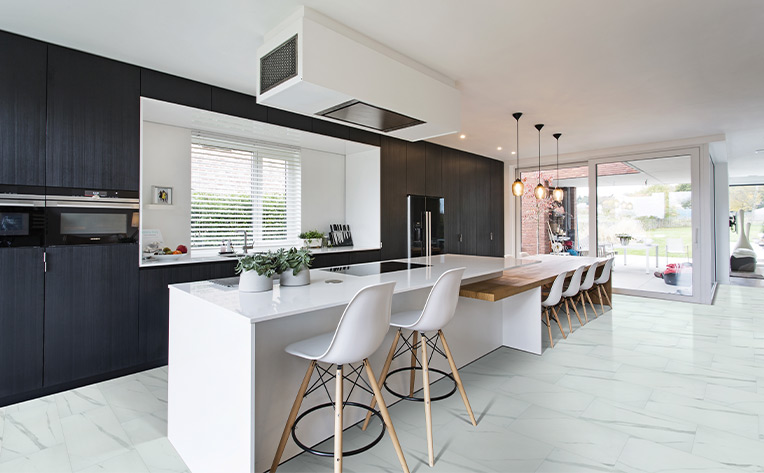
The best kitchen flooring needs to handle moisture, resist scratches and stains, and look good doing it. Here's what to know before you choose.
The best flooring materials for kitchens are tile and luxury vinyl. Both are fully waterproof, stand up to heavy daily use, and come in a wide range of styles. Hardwood and laminate can both work in a kitchen too, but each comes with trade-offs worth understanding before you choose. The sections below walk through each material, what makes it a good or risky fit for a kitchen, and the most common questions homeowners ask about each one. As your friendly flooring experts, we're here to help you find guidance on getting your project started in our starting a project FAQ.
Tile is one of the most popular kitchen flooring choices, and for good reason. It's fully waterproof, extremely durable, and easy to clean, which makes it well suited to a room where spills and heavy foot traffic are part of daily life. Tile also holds up well under the weight of appliances and stands up to drops and scratches better than most other flooring types.
Porcelain tile is the standard recommendation for kitchen floors. It has a very low water absorption rate, which makes it more resistant to moisture damage than ceramic, and its dense composition holds up well to heavy foot traffic, dropped items, and the weight of appliances. Ceramic tile is also durable and works well for kitchens, but it is often a better fit for walls and backsplashes than for the floor itself, where porcelain's lower absorption rate gives it an edge.
Shop kitchen tile flooring to browse options built for this room, or shop tile flooring to see the full collection.
Luxury vinyl, in both plank (LVP) and tile (LVT) formats, is one of the best all-around choices for a kitchen. It's fully waterproof, more comfortable underfoot than tile or hardwood, and available in a wide range of wood and stone looks.
Yes, vinyl flooring is one of the best kitchen flooring options available. Whether you choose LVP or LVT, it is fully waterproof, which protects against the spills, splashes, and moisture that are unavoidable in a kitchen. It is also durable enough to handle dropped dishes, pet traffic, and the daily wear of a busy household, and it is more comfortable to stand on for long periods than tile or hardwood.
Vinyl is the better choice for kitchens. The key difference comes down to waterproofing: vinyl (LVP and LVT) is fully waterproof, while laminate is only water-resistant and can be damaged by sustained moisture exposure at the seams. In a room where water reaches the floor regularly, that difference matters. Laminate can be a fine choice for lower-moisture rooms, but in the kitchen specifically, vinyl is the stronger pick. For a full side-by-side comparison, see our guide to laminate vs. vinyl flooring.
Yes, you can put a refrigerator on vinyl plank flooring with a few precautions. A refrigerator is heavy and stays in one spot for a long time, which can cause indentations in the flooring if the weight is not spread out. Using furniture pads or a protective mat under the refrigerator's feet helps distribute the weight and prevents the floor from developing permanent dents. This is especially worth doing with thinner LVP products or softer WPC cores.
Shop kitchen vinyl flooring to browse options built for this room, or shop vinyl flooring to see the full collection.
Hardwood brings warmth and a timeless look to an open-concept kitchen. It's a good fit for homeowners who want continuity between their kitchen and the rest of their main living space. That said, the kitchen is one of the more demanding rooms for hardwood, and it's worth understanding the trade-offs.
Hardwood can work in a kitchen, but it's not without risk. Solid hardwood is sensitive to moisture, and the spills, splashes, and humidity that come with everyday kitchen use can lead to warping, cupping, or staining over time. Engineered hardwood is a better fit for kitchens than solid hardwood, since its layered construction is more stable and better able to handle minor moisture and temperature changes. If a wood look is a priority for your kitchen, engineered hardwood is the more practical choice.
The biggest concern with hardwood in the kitchen is moisture. Water that sits on the floor, especially around a sink, dishwasher, or refrigerator, can cause the wood to warp, cup, or develop dark stains over time. Hardwood is also more prone to scratching from dropped pans, pet nails, and chairs being pulled across the floor than tile or vinyl. And while hardwood can be refinished, doing so in a kitchen with built-in cabinetry and appliances takes more work than in an open room, which can make repairing a damaged section more disruptive.
Engineered hardwood with a water-resistant core is the best option for a kitchen. Its layered construction resists the expansion and contraction that causes solid hardwood to warp in humid or wet conditions. Within engineered hardwood, harder wood species like oak and hickory hold up better to dropped dishes, pet traffic, and daily wear than softer species like pine.
Shop hardwood flooring to explore engineered hardwood options.
Laminate can be a budget-friendly option for a kitchen, but it comes with an important caveat: standard laminate is water-resistant, not waterproof. It can handle minor spills if they are cleaned up promptly, which makes it workable for kitchens where moisture exposure is limited. It is not recommended near dishwashers, sinks, or other areas where water exposure happens often or lasts a while, since moisture that gets past the surface and into the seams can cause the core to swell and warp. If waterproofing is a priority for your kitchen, waterproof laminate or luxury vinyl are better suited to the job. For more on how laminate compares to vinyl specifically for kitchens, see the Luxury Vinyl section above.
Shop laminate flooring to browse available options.
Tile and luxury vinyl are the best overall choices for most kitchens. Both are fully waterproof, highly durable, and easy to maintain, which makes them well suited to a room where spills, foot traffic, and dropped items are part of everyday life.
Porcelain tile offers exceptional durability and a wide range of looks, while LVP and LVT offer similar waterproof performance with a softer feel underfoot. Hardwood and laminate can also work in a kitchen, but each comes with moisture-related trade-offs.
As your friendly flooring experts, we're here to help you compare options based on your kitchen's layout and your household's needs. Shop all kitchen flooring to browse every material in one place, or find a store near you to get hands-on guidance.